Surah An-Nas Benefits: Refuge from the Whisperer Within
بِسْمِ اللَّهِ الرَّحْمَٰنِ الرَّحِيمِ
Surah An-Nas – The Refuge for Mankind
In brief: A seeker who feels uneasy, haunted by unseen whispers, or burdened by physical discomfort turns to Surah An‑Nas for its concise divine refuge. Its six verses enumerate Allah’s lordship over mankind, His kingship, and His godhood, then call for protection from the retreating whisperer who instils doubt into hearts.
In pain → Healing · Feeling unsafe → Protection · Want to understand it → Station & Meaning
مَلِكِ النَّاسِ
إِلَٰهِ النَّاسِ
مِن شَرِّ الْوَسْوَاسِ الْخَنَّاسِ
الَّذِي يُوَسْوِسُ فِي صُدُورِ النَّاسِ
مِنَ الْجِنَّةِ وَالنَّاسِ
What Surah An-Nas Is About
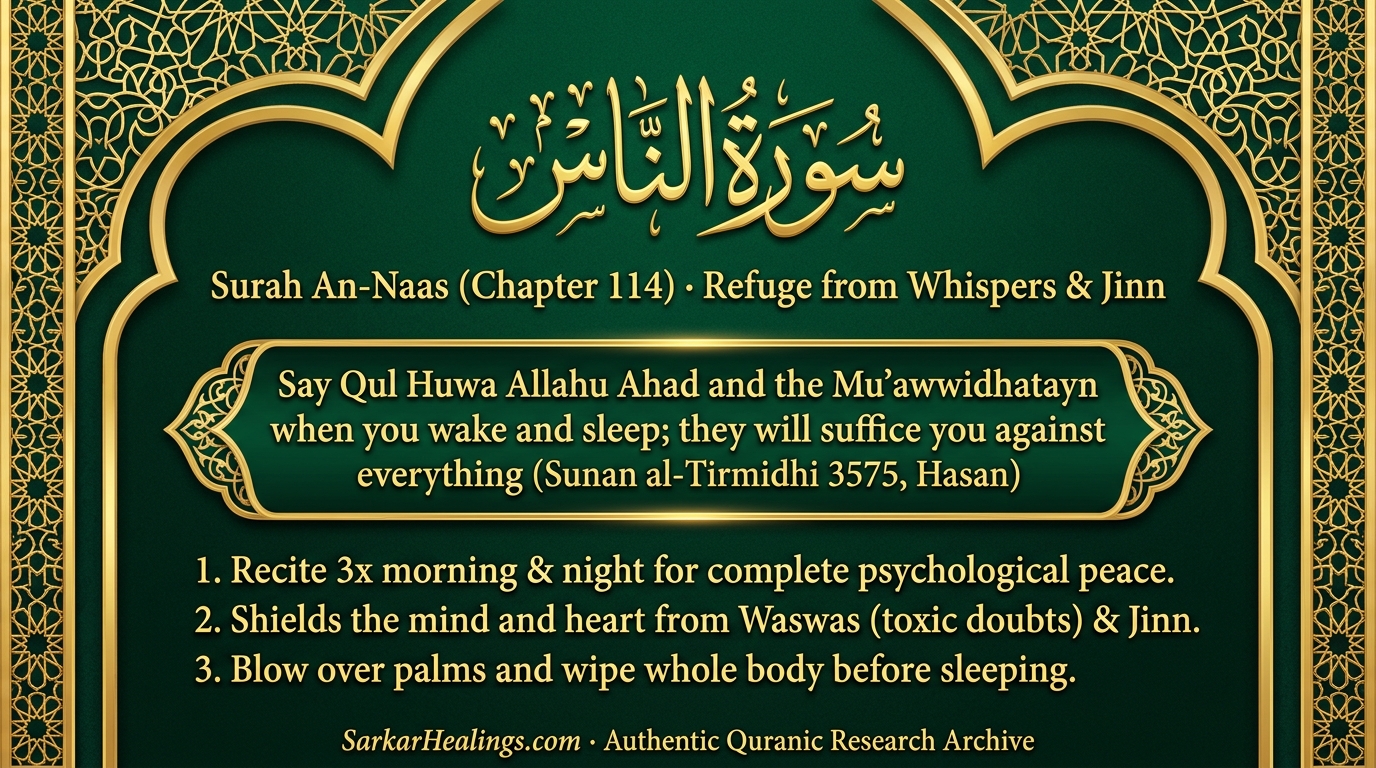
Surah An‑Nas, the 114th chapter of the Qur’an, is a Makki revelation consisting of six concise verses. It is commonly paired with Surah Al‑Falaq as the Ma’udhatayn, the two chapters of refuge. The surah opens with a triple declaration of Allah’s relationship to humanity: He is the Lord (Rab) who nurtures and sustains, the King (Malik) who holds ultimate authority, and the God (Ilah) worthy of exclusive worship.
Following this affirmation, the surah turns to a plea for protection. It asks Allah to shield the believer from the “whisperer” (al‑waswās) who withdraws after instilling doubt, a force that operates unseen among both jinn and mankind. The verses thus encapsulate a comprehensive spiritual safeguard: acknowledging divine sovereignty while seeking refuge from covert influences that aim to disturb the heart and mind.
The Benefits of Surah An-Nas – Every Claim Sourced
🌿 Healing
- Reciting Surah An‑Nas on any part of the body that is experiencing pain can lead to relief of that discomfort.
- The surah’s recitation is mentioned as a means to alleviate grief, sorrow, and pain for the one who recites it.
- When the written text of Surah An‑Nas is placed as a talisman (tawiz) around a child’s neck, the child is safeguarded from harmful influences that could manifest as physical unease.
- Regular recitation of the Ma’udhatayn (which includes Surah An‑Nas) before sleep is described as a protective practice that contributes to overall well‑being by warding off nocturnal disturbances.
If recited on any body part that is paining, the pain will be relieved.
🛡️ Protection
- Whoever recites Surah An‑Nas in his house every night will be kept safe from Jinn and the evil designs of Shaitan.
- Placing the written text of Surah An‑Nas around a child’s neck as a tawiz protects the child from Jinn.
- Reciting the Ma’udhatayn (Surah An‑Nas together with Surah Al‑Falaq) before sleeping places the reciter under Allah’s protection until morning, shielding him from harm.
- If Surah An‑Nas is recited in a house, that dwelling remains free from Jinn and evil spirits.
- The reciter of Surah An‑Nas experiences freedom from grief, sorrow, and pain, and is guarded against harmful whispers from both jinn and mankind.
Whoever recites in his house every night, will be kept safe from Jinn and the evil designs of Shaitan.
🌟 Station & Meaning
- Surah An‑Nas affirms Allah’s triple role as Lord, King, and God of mankind, establishing the theological foundation for seeking His refuge.
- The surah’s designation as part of the Ma’udhatayn highlights its status as a chapter of refuge, frequently recited for spiritual safeguarding.
- By acknowledging the whisperer’s retreat, the believer learns to recognize and dismiss covert negative influences that arise from unseen sources.
- The concise six‑verse structure makes Surah An‑Nas accessible for regular recitation, facilitating continual remembrance of divine protection.
How and When to Use – Prescription
Before any use: seek refuge (isti’adhah), begin with Bismillah, recite with tarteel (measured pace), close with Ameen.
| When | How to Use | What It Does |
|---|---|---|
| Daily prayer (after each obligatory salah) | Recite Surah An‑Nas once, reflecting on its meaning. | Reinforces awareness of Allah’s lordship and invites ongoing protection. |
| Before retiring to sleep | Recite Surah An‑Nas (and optionally Surah Al‑Falaq) three times. | Places the reciter under Allah’s guard until morning, warding off nocturnal disturbances. |
| Experiencing bodily pain or discomfort | Place the hand on the painful area and recite Surah An‑Nas seven times. | Aims to alleviate the pain through the stated prophetic narration. |
| Feeling uneasy or suspecting negative whispers | Recite Surah An‑Nas silently, focusing on the verses about the retreating whisperer. | Seeks to dispel unsettling thoughts attributed to jinn or human sources. |
| Protecting a child | Write Surah An‑Nas on a small piece of paper, place it in a pouch, and tie it around the child’s neck. | Intends to shield the child from Jinn‑related harm as per the narration. |
How to Get Maximum Benefit
- Intention (niyyah): Begin each recitation with a clear purpose—seeking Allah’s protection, healing, or peace.
- Consistency: Incorporate Surah An‑Nas into regular routines, such as after prayers and before sleep, to build a habit of remembrance.
- Certainty (yaqin): Trust that the recitation is a means through which Allah’s mercy can manifest, without demanding specific worldly outcomes.
- Pairing with good deeds: Combine the recitation with acts of kindness, charity, and sincere repentance to enhance spiritual receptivity.
Listen to Sheikh’s Recitation — Surah An-Nas
Recited by Sheikh Sayed — listen with khushu, read along, then recite yourself. For personal recitation guidance, message on WhatsApp.
Frequently Asked Questions
What is the meaning of “Ma’udhatayn”?
The term Ma’udhatayn refers to the two chapters of refuge, Surah Al‑Falaq and Surah An‑Nas, which are often recited together for protection from external and internal harms.
Can Surah An‑Nas replace medical treatment for pain?
No. The recitation is a spiritual practice that may bring comfort, but it does not substitute professional medical advice or treatment.
Is the narration about pain relief authentic?
The narration stating that reciting Surah An‑Nas on a painful body part will relieve the pain appears in Fawaid-e-Quran, attributed to Imam Ja’far as-Sadiq (a). As the source does not provide a specific hadith number or chain details, the authenticity should be verified .
How often should I recite Surah An‑Nas for household protection?
The narration recommends reciting Surah An‑Nas every night in the house to keep it safe from Jinn and the evil designs of Shaitan.
Where Surah An‑Nas Fits in Your Journey
Surah An‑Nas serves as a concise yet powerful touchstone for anyone navigating moments of vulnerability—whether physical discomfort, unsettling thoughts, or a sense of exposure to unseen influences. By repeatedly turning to its six verses, the believer cultivates a habit of acknowledging Allah’s supreme lordship, kingship, and godhood while actively seeking His shelter from the subtle whispers that aim to disturb the heart. In this way, the surah becomes a steady companion on the path of spiritual resilience, reminding the seeker that ultimate safety lies in the Divine Refuge.
Cross-Links
- Protection & Safety Hub
- Anxiety & Distress Hub
- Health & Shifa Hub
- Continue with Surah Al-Falaq
- All 114 Surahs
Get the Complete Quran Coded Dua Taweez
WhatsApp Sheikh Sayed — Personal Guidance