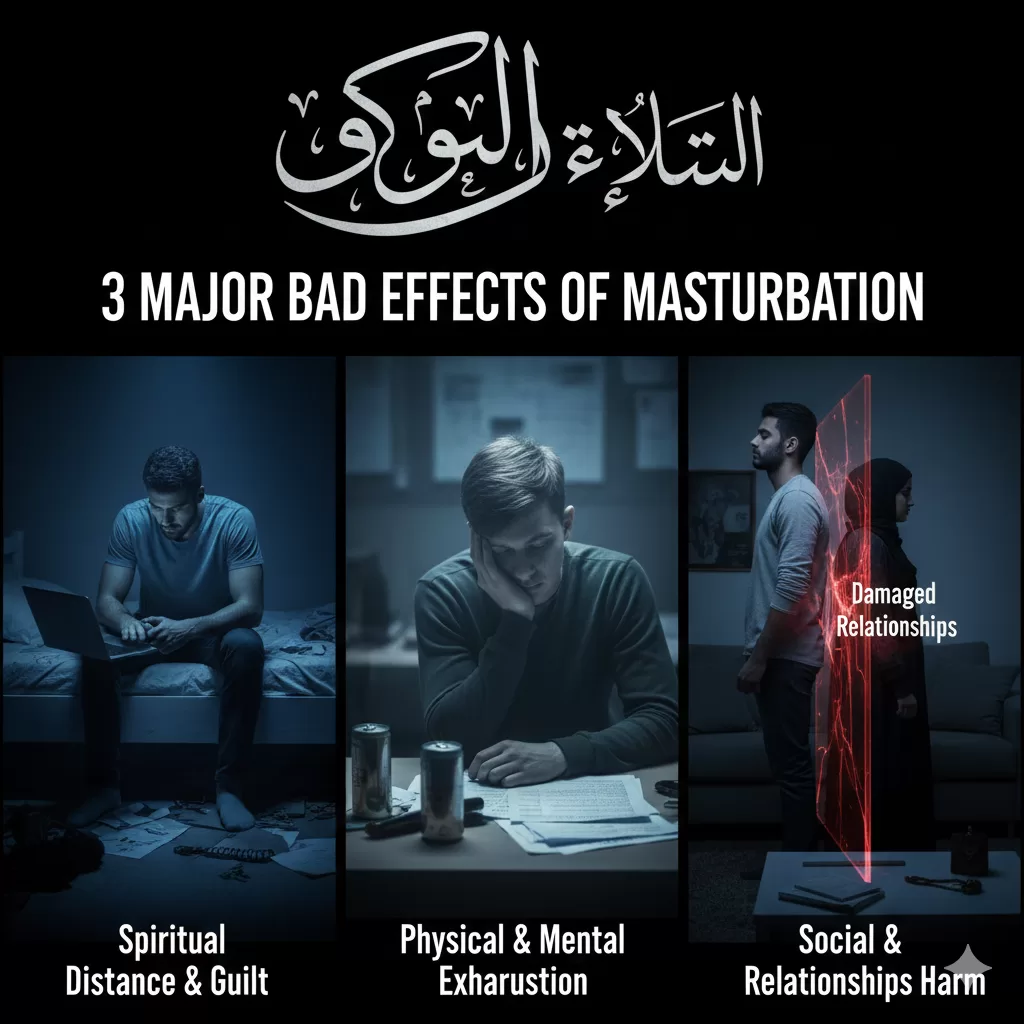
Islam and Masturbation; 3 Major Bad Effects of Masturbation
Islam and Masturbation: Complete Guide for Those Struggling with Addiction
A comprehensive Islamic guide covering spiritual harms, physical effects, scholarly rulings, and a proven 40-day recovery plan to overcome masturbation addiction through Quranic wisdom and prophetic guidance.
⚠️ Important Notice: Sensitive Topic Discussed with Respect
This article addresses a deeply personal struggle affecting millions of Muslims worldwide. We approach this topic with the seriousness it deserves—rooted in Quranic verses, authentic Hadith, and classical scholarly wisdom. If you're struggling, know that you are not alone, and Allah's mercy is infinite. This guide exists to help you find healing, not shame.
Is Masturbation Haram (Forbidden) in Islam? The Quranic Evidence
The Islamic ruling on masturbation (Arabic: istimna or jalad/istimna bil-yad) is primarily based on Surah Al-Mu'minun, where Allah ﷻ describes the characteristics of successful believers:
Quran 23:5-7 (Surah Al-Mu'minun):
"And those who guard their private parts, except from their wives or those their right hands possess, for indeed, they will not be blamed. But whoever seeks beyond that, then those are the transgressors."
— Translation: Sahih International
🕌 Spiritual Protection Using Surah Al-Mu'minun
This very surah—which prohibits masturbation—can also be your shield against the urge. Classical scholars recommend wearing verses from Surah Al-Mu'minun as spiritual protection from sexual sins.
How It Works: The Quranic verses create a spiritual barrier around you, making it difficult for shaytan to whisper lustful thoughts. Many recovering Muslims report significant reduction in urges when wearing this taweez consistently.
→ Get Surah Al-Mu'minun Taweez for Chastity ProtectionCombine with fasting, dhikr, and lowering the gaze for comprehensive recovery.
Scholarly Interpretation & Consensus
The Majority Position (Jumhur): The majority of Islamic scholars across all four Sunni madhabs (Hanafi, Maliki, Shafi'i, Hanbali) and Shia jurisprudence conclude that masturbation is haram (forbidden) based on the verse above [web:154][web:157][web:163].
The Logic: Allah ﷻ permitted sexual satisfaction only through two lawful means:
- Spouses (married partners)
- Lawful bondwomen (historically, though this is no longer applicable)
The verse explicitly states: "Whoever seeks beyond that, then those are the transgressors." Masturbation falls into "seeking beyond" the two permitted categories, thus constituting transgression (udwan) [web:163].
🚫 The Severity of the Sin
Classical scholars categorized masturbation as a major sin (kabira) when done habitually. Imam Shamsuddin al-Dhahabi (رحمه الله) listed it among Al-Kaba'ir (The Major Sins), citing a hadith that includes masturbators among seven groups cursed by Allah on the Day of Judgment—unless they repent sincerely [web:154][web:157].
The Minority Exception (Discussed Later)
Some Hanafi scholars permitted masturbation in extreme necessity only—when there is genuine fear of committing zina (fornication/adultery) and marriage is impossible. This will be addressed in detail in the scholarly exception section [web:163].
Why So Many Muslims Struggle: The Hidden Epidemic
If masturbation is so clearly prohibited, why do millions of Muslims—including practicing, mosque-going believers—struggle with this addiction? Understanding the modern context helps us approach recovery with compassion, not just condemnation [web:154][web:157][web:160].
1. Delayed Marriage in Modern Muslim Society
In the Prophet's ﷺ time, Muslims married young (often mid-to-late teens). Today, especially in the West and educated Muslim countries, marriage happens in late 20s or early 30s due to:
- Pursuing higher education (bachelor's, master's, PhD)
- Financial instability (needing career establishment first)
- Cultural expectations (expensive weddings, housing, mahr demands)
- Lack of halal socialization opportunities to meet potential spouses
Result: 10-15 years of sexual maturity without halal outlet, creating immense struggle [web:160][web:163].
2. Hyper-Sexualized Digital Environment
Previous generations didn't face:
- Pornography accessible 24/7 on smartphones (70% of Muslim youth have accessed it—Islamic surveys)
- Social media filled with immodest images and provocative content
- Dating apps and hookup culture normalization
- Streaming shows/movies with explicit scenes
Allah ﷻ commands in Quran 24:30-31: "Tell the believing men to lower their gaze and guard their private parts... And tell the believing women to lower their gaze and guard their private parts..." This divine directive applies to all Muslims regardless of gender [web:163].
3. Lack of Islamic Sexual Education
Most Muslim families avoid discussing sexuality, leaving youth to:
- Learn from Western sex-ed (which promotes masturbation as "healthy")
- Get information from peers or internet (often incorrect)
- Feel shame asking scholars or parents
- Not understand the why behind the prohibition
This guide aims to fill that void with authentic Islamic knowledge.
4. Mental Health & Trauma Factors
Contemporary Islamic psychology and modern research show that compulsive masturbation often stems from:
- Stress/anxiety coping mechanism: Dopamine release provides temporary relief from overwhelming emotions
- Depression and loneliness: Particularly affecting Muslims in diaspora communities (USA, UK, Canada, Australia) or those geographically separated from Islamic support networks [web:159]
- Past sexual trauma or abuse: Re-traumatization through compulsive sexual behavior as a maladaptive coping mechanism
- Low self-esteem: Seeking validation or escape through sexual gratification
Allah ﷻ recognizes our struggles. The goal isn't shame—it's healing through tawbah and spiritual discipline [web:154][web:156][web:157].
The 3 Major Categories of Harm from Masturbation
Classical Islamic scholars and modern Muslim physicians document extensive harms across three dimensions: spiritual, physical, and psychological [web:154][web:158][web:159][web:163].
1. Spiritual Harms (The Most Devastating)

The spiritual consequences affect your relationship with Allah ﷻ and your ability to worship:
- Decrease in Tawfiq (Divine Success): Allah's barakah (blessings) are withdrawn from your life—nothing goes smoothly despite effort [web:154][web:157]
- Hardness of Heart (Qas'wat al-Qalb): You become spiritually numb—Quranic verses don't move you, remembrance of death doesn't affect you [web:157]
- Inability to Concentrate in Prayer: Your salah becomes mechanical, filled with wandering thoughts (especially sexual thoughts during sujood—a common complaint) [web:154][web:160]
- Deprivation of Tahajjud & Night Worship: As Hasan al-Basri (رحمه الله) famously said: "A person deprives himself of performing Tahajjud by committing sins." The sweetness of standing before Allah in the last third of night is lost [web:154][web:157]
- Loss of Interest in Quran & Islamic Knowledge: The mushaf collects dust. You skip religious gatherings. Islamic content feels boring while haram content feels exciting [web:154][web:163]
- Increased Vulnerability to Shaytan: Each sin opens a door for shaytan. Masturbation often leads to pornography, which leads to zina thoughts, which can lead to actual zina—a slippery slope [web:160][web:161]
- Difficulty Making Dua: You feel too ashamed to raise hands to Allah, thinking "How can I ask Him for anything when I keep disobeying Him?" This is shaytan's trap to prevent your tawbah [web:154][web:157]
- Isolation from Righteous Company: You avoid good Muslims because their piety makes you uncomfortable. You drift toward those who also sin, creating echo chambers of disobedience [web:154]
The Ultimate Spiritual Harm: In severe cases, persistent masturbation (especially with pornography) can lead to doubts about Islam itself. Shaytan whispers: "If you can't even stop this, what's the point of trying to be a good Muslim?" This despair (ya's) is exactly what shaytan wants—driving you away from Allah's infinite mercy [web:157].
2. Physical Harms (Documented by Classical & Modern Medicine)
While some modern secular medicine claims masturbation has "no side effects" (actually promoting it as healthy), both classical Islamic medical texts (Tibb al-Nabawi tradition) and contemporary research on addiction (not occasional acts) show numerous harms [web:156][web:158]:
Sexual & Reproductive System:
- Weakened sexual organs: Chronic stimulation causes premature looseness and decreased sensitivity [web:158]
- Erectile dysfunction (ED): Especially in those who use pornography—the brain becomes desensitized to normal arousal, leading to performance anxiety and impotence in marriage [web:156].⚠️ If You're Already Experiencing Impotency: Many brothers who struggled with chronic masturbation report erectile dysfunction even after quitting. Islamic spiritual healing can help restore what was lost.
Recommended Solutions:- → Taweez & Coded Dua for Impotency (Quranic verses for restoring manhood)
- → Dua for Stamina & Overcoming Impotence (Prophetic supplications for strength)
Note: Combine spiritual healing with medical consultation for best results.
- Premature ejaculation: Loss of control over ejaculatory reflex, harming future marital relations [web:158]
Sexual & Reproductive System:
- Weakened sexual organs: Chronic stimulation causes premature looseness and decreased sensitivity [web:158]
- Erectile dysfunction (ED): Especially in those who use pornography—the brain becomes desensitized to normal arousal [web:156]
- Premature ejaculation: Loss of control over ejaculatory reflex, harming future marital relations [web:158]
- Testicular inflammation: Seminal vesicles become inflamed from excessive stimulation [web:158]
- Excessive wet dreams (ihtilam): Body tries to compensate, leading to frequent nocturnal emissions [web:158]
Neurological & Cognitive:
- Memory weakness: Dopamine addiction rewires brain, affecting hippocampus (memory center) [web:156][web:158]
- Weakened concentration: ADHD-like symptoms from dopamine dysregulation [web:156]
- Brain fog: Difficulty thinking clearly or making decisions [web:158]
- Cerebral gland weakening: Classical texts mention harm to pituitary and pineal glands [web:158]
Musculoskeletal & Energy:
- Lower back pain: Chronic pelvic floor tension and nerve strain [web:158]
- Spinal/vertebral pain: Especially in those who masturbate in unhealthy positions [web:158]
- Leg tremors/weakness: Nerve pathway disruption from excessive stimulation [web:158]
- Chronic fatigue: Semen production requires immense bodily resources (hadith: "80 drops of blood = 1 drop of semen")—excessive loss depletes the body [web:158]
Systemic Effects:
- Weakened immune system: Body's natural defenses lowered [web:158]
- Premature aging: Cellular oxidative stress from hormonal imbalance [web:158]
- Eyesight deterioration: Classical texts link sexual excess to vision problems (Ayurveda and Unani medicine concur) [web:158]
- Heart, liver, stomach, brain stress: The four principal organs are overtaxed [web:158]
Important Nuance: These harms primarily result from chronic, compulsive masturbation (addiction), not an isolated incident. The body has some resilience, but habitual abuse causes cumulative damage.
Systemic Effects:
- Weakened immune system: Body's natural defenses lowered, making you more susceptible to infections and diseases [web:158]
- Increased risk of serious illness: Chronic sexual sins weaken the body's resistance, and some classical scholars noted correlations between sexual excess and susceptibility to severe diseases.🛡️ Prophetic Protection from Illness: The Prophet ﷺ taught us to seek Allah's protection from all diseases—physical and spiritual. Regular recitation of protective duas strengthens your immune system on both levels.
→ Read: Dua to Protect from Cancer & Serious DiseasesIncludes Quranic verses and Prophetic supplications for comprehensive health protection.
- Premature aging: Cellular oxidative stress from hormonal imbalance [web:158]
3. Psychological & Social Harms
The mental health impact is profound and often underestimated [web:154][web:156][web:157][web:159]:
- Guilt-Shame-Relapse Cycle: You feel crushing guilt after masturbating → make tawbah → feel better for few days → triggers arise → relapse → deeper guilt. This cycle creates learned helplessness: "I can't stop, I'm hopeless" [web:154][web:157]
- Low Self-Esteem & Self-Hatred: You see yourself as "weak," "disgusting," "not a real Muslim"—destroying confidence in all life areas [web:156][web:157]
- Social Anxiety & Withdrawal: Fear that others can "see" your sin. Avoiding masjid, Islamic events, good company. Isolating in your room (where more relapses occur) [web:154][web:156]
- Depression & Anhedonia: Loss of pleasure in normal activities. Nothing feels rewarding except the compulsive behavior, particularly affecting Muslims living as religious diaspora in non-Muslim majority countries or those isolated from Islamic community support [web:156][web:159]
- Anxiety Disorders: Constant worry about getting caught, fear of punishment, dread of never changing [web:156][web:159]
- Inability to Form Healthy Relationships: Viewing those they're attracted to as sexual objects (if using pornography), difficulty with emotional intimacy, unrealistic expectations for future spouses [web:156][web:159]
- Cowardice & Lack of Willpower: As Ibn Qayyim (رحمه الله) noted: Habitual sin weakens the nafs (self) until you have no strength to resist any desire—not just sexual ones [web:154][web:158]
📿 The Prophet's ﷺ Diagnosis:
"Many sinners sin without deriving any pleasure and urge except that they experience pain in quitting it."
— Ibn Qayyim al-Jawziyyah (رحمه الله), Al-Jawab al-Kafi
This perfectly describes addiction: you no longer masturbate for pleasure—you do it to escape the pain of NOT doing it. This is the trap that must be broken [web:158].
Powerful Hadiths Warning Against Misuse of Private Parts
The Prophet Muhammad ﷺ explicitly warned about guarding one's private parts and tongue—the two gateways to either Paradise or Hell [web:163].
📿 Hadith #1: The Guarantee of Jannah
"Whoever gives me the assurance regarding what is between their jaws and their legs (i.e., not to unlawfully use the tongue and the private parts), I give them the assurance of Heaven."
Narrator: Sahl ibn Sa'd (رضي الله عنه)
Source: Sahih al-Bukhari
Meaning: Control your speech (no lying, backbiting, vulgarity) AND your private parts (no zina, masturbation, homosexuality)—and Paradise is guaranteed. These are the two primary tests.
📿 Hadith #2: Protection Equals Paradise
"Whoever Allah protects from the evil of what is between their jaws and between their legs will enter Paradise."
Narrator: Abu Hurairah (رضي الله عنه)
Source: Jami' at-Tirmidhi (Hasan Sahih)
Scholars say: This hadith emphasizes that sexual sins and tongue sins are the primary causes of entering Hell. Protect these two, and most other sins become manageable [web:163].
📿 Hadith #3: The Seven Cursed Groups
"Seven people are such that Allah has cursed them, and He will not even cast a look of mercy upon them on the Day of Judgment. Allah will tell them to enter Hell with the people going to Hell—except those who repent."
The Seven Include:
- One who performs sodomy (active participant)
- One upon whom sodomy is performed (passive participant, if consensual)
- One who does immoral acts with animals (bestiality)
- One who marries his mother or sister (incest)
- One who masturbates
Source: Narrated by Imam Shamsuddin al-Dhahabi in Kitab al-Kaba'ir (The Book of Major Sins), p.48
⚠️ Critical Caveat: Notice the clause "except those who repent." This isn't a death sentence—it's a severe warning to motivate SINCERE TAWBAH. Allah's mercy is always available for those who turn back to Him [web:154][web:157].
📿 Hadith #4: The Pregnant Hands (Day of Judgment)
"I have heard that on the Day of Judgment, a group will be brought forth in such a state that their hands will be pregnant. I think they are the masturbators."
Narrator: Ata' ibn Abi Rabah (تابعي, Student of Companions)
Source: Mentioned by Allama Mahmood Alusi in Ruh al-Ma'ani, Tafsir of Surah Al-Mu'minun
Interpretation: This is a metaphorical punishment—on Yawm al-Qiyamah, people will be resurrected in forms that symbolize their primary sins. "Pregnant hands" signifies misuse of hands for sexual sin. It's a humiliating public exposure of what was done in secret.
📿 Hadith #5: Allah Will Punish a Group for Misusing Private Parts
"Allah, the Supreme, will inflict punishment on a group of people because they misused their private parts."
Narrator: Sa'eed ibn Jubayr (رحمه الله), Great Tabi'i
Source: Narrated by Allama Alusi in Ruh al-Ma'ani, Vol. 18, p.291
Context: This includes all sexual sins—zina, sodomy, and yes, masturbation. The private parts are an amanah (trust) from Allah. Violating that trust carries consequences [web:163].
📿 Hadith #6: "Nikah with the Hand" is Cursed
"The person who performs marriage (nikah) with his hands [i.e., masturbates] is cursed."
Narrator: Sayyiduna Anas ibn Malik (رضي الله عنه)
Source: Mentioned in Fatawa Razaviyya, Vol. 10, p.80 (Hanafi school compilation)
Why "cursed"? Because it mocks the sacred institution of marriage. It's a perverse imitation of the halal intimacy Allah designed for spouses, done in shameful secret [web:163].
The Solution Offered in Hadith
✅ The Prophetic Prescription
"O group of youth! Whoever from among you can marry, should do so—because it keeps the gaze low and it protects the private parts. And he who cannot marry should fast, because fasting breaks lust."
Narrator: Abdullah ibn Mas'ood (رضي الله عنه)
Source: Sahih Muslim, Book of Marriage (Kitab al-Nikah)
The Two-Pronged Solution:
- First choice (if able): Get married. Don't delay. Marriage is half your deen and the ONLY halal outlet for sexual urges [web:160][web:163].
- Second choice (if unable): Fast regularly. Not just Ramadan—Sunnah fasts (Mondays/Thursdays, 3 white days, every other day like Dawood AS). Fasting is a "shield" (wija) that suppresses sexual desire both physically (hunger) and spiritually (discipline) [web:154][web:160][web:161][web:163].
Notice what the Prophet ﷺ did NOT say: "If you can't marry, then masturbate to relieve yourself." He offered fasting, not self-gratification. This is the Prophetic way [web:163].
The Scholarly Exception: When Is Masturbation Permissible?
While the majority position is clear prohibition, it's intellectually honest to present the minority opinion held by some Hanafi scholars—not to encourage the act, but to show Islamic jurisprudence's nuance and mercy [web:163].
The Hanafi Exception (Extreme Necessity Only)
⚖️ Mufti Waqar-ud-Din al-Qadri's Ruling
From Waqar al-Fatawa, Vol. 1, p.269 (Hanafi school):
"If a person is overpowered by sexual desire to such an extent that there is genuine fear of him committing zina (fornication/adultery), and he is absolutely not capable of marrying, or his wife is so far away that he cannot reach her—then in such cases, it is hoped there is no punishment for the one who does this [masturbation] out of necessity to prevent a greater sin."
The Conditions Are EXTREMELY Strict:
- Imminent Danger of Zina: Not just "I feel aroused." It must be a situation where you genuinely believe you will commit actual zina (fornication or adultery) if you don't release the tension. Example: A married man whose wife is abroad for 6 months, experiencing unbearable urges, and there are opportunities for zina around him [web:163].
- Marriage Absolutely Impossible: You cannot marry due to objective barriers (financial, legal, circumstances)—not just "I don't feel ready." The Hanafi scholars meant situations like imprisonment, extreme poverty, or being stranded in a foreign land [web:163].
- Spouse Genuinely Inaccessible: If married, your spouse must be far away (different country, long-term separation) with no means to reach them [web:163].
- Intention Must Be Protective, Not Pleasure: This is the key distinction Allama Ibn Abidin makes in Radd al-Muhtar: "If he does this with the intention of saving himself from committing sin (i.e., zina), it will not be a sin. But if he does it with the intention of enjoyment and pleasure, he will be a sinner" [web:163].
🚫 THIS EXCEPTION DOES NOT APPLY TO 99.9% OF CASES
Do NOT use this as a loophole. The scholars were addressing edge-case scenarios (think: Muslim slave in medieval times, married Muslim prisoner, etc.)—NOT the average Muslim youth scrolling Instagram at 2 AM who "can't control himself."
If you're using this exception to justify habitual masturbation, you're deceiving yourself. The conditions require:
- No access to pornography (that's ADDITIONAL sin)
- No lustful thoughts of specific women (also haram)
- Purely mechanical release to prevent imminent zina
- Immediate regret and tawbah afterward
Most importantly: If you're addicted to masturbation and doing it multiple times a week, you are NOT in a state of "extreme necessity"—you're in a state of addiction that requires recovery [web:154][web:156][web:158].
The Majority Scholars' Response
Maliki, Shafi'i, and Hanbali scholars (and many Hanafis) reject even this exception, arguing:
- The Quran's wording "whoever seeks beyond that, then those are transgressors" is absolute—no exceptions mentioned [web:163]
- The Prophet ﷺ prescribed fasting as the solution, not masturbation [web:154][web:160][web:161][web:163]
- Opening this door leads to abuse—people will claim "necessity" when it's really just lack of willpower
The safest position for your deen: Treat all masturbation as haram, make sincere tawbah every time, and follow the 40-day recovery plan below [web:154][web:157][web:158].
How to Make Sincere Tawbah: Allah's Mercy is Greater Than Your Sin
💚 The Most Important Section: Never Lose Hope
"The one who repents is like one who has not sinned."
— Prophetic Hadith (Ibn Majah, Hasan)
No matter how many times you've relapsed—10 times, 100 times, 1000 times—Allah's door of mercy is ALWAYS open. Shaytan's greatest victory is making you despair of Allah's forgiveness. Do not give him that victory [web:154][web:157].
"O Allah, You are my Lord, none has the right to be worshipped except You. You created me and I am Your servant. I abide by Your covenant and promise as best I can. I seek refuge in You from the evil of what I have committed. I acknowledge Your favor upon me and I acknowledge my sin, so forgive me, for verily none can forgive sin except You."
Recite 3-7 times [web:154][web:157].💡 Need More Duas for Forgiveness? Islamic scholars have compiled powerful supplications specifically for erasing sexual sins and restoring spiritual purity.
→ Read: Best Dua for Forgiveness of Sins (Complete Collection)Includes duas from Quran and Sunnah for major sins, with Arabic text, transliteration, and meanings.
The 5 Pillars of Valid Tawbah (Repentance)
For your repentance to be accepted, scholars say it must include these elements [web:154][web:157][web:161]:
- Immediate Cessation (Iqla'): Stop the sin right away. Don't say "I'll quit after this last time" or "after Ramadan." The moment you finish reading this, if you're in a state of sin, stop NOW [web:154][web:157].
- Sincere Regret (Nadm): Feel genuine remorse—not just fear of punishment, but sorrow that you disobeyed Allah who gives you everything. Cry if you can. The Prophet ﷺ said: "Regret is repentance itself" (Ibn Majah) [web:154][web:157].
- Firm Resolve Never to Return ('Azm 'Ala An La Ya'ud): Make a sincere intention: "I will never do this again." Even if you relapse tomorrow, this intention TODAY is required. You're not lying—you genuinely mean it in this moment [web:154][web:157][web:161].
- Make Amends (If Applicable): Masturbation doesn't usually involve rights of others, but if you used someone's image/video (pornography), delete everything immediately. If you influenced others toward this sin, warn them and help them quit [web:154].
- Do Good Deeds to Erase the Sin: The Prophet ﷺ said: "Undoubtedly, virtues wipe away sins" (Quran 11:114). After repenting, do extra salah, give sadaqah, recite Quran, help someone—good deeds erase bad deeds [web:154][web:157].
The Practical Tawbah Ritual (Do This Right After Relapse)
✅ 7-Step Post-Relapse Protocol
Implement this IMMEDIATELY after every incident to break the shame cycle [web:154][web:157][web:161]:
- Perform Ghusl (Ritual Bath): Masturbation requires ghusl just like sexual intercourse. This physically and spiritually cleanses you. As you wash, make intention of purification from sin [web:161].
- Pray 2 Rakat Salat al-Tawbah: This is a Sunnah prayer specifically for repentance. Recite longer surahs if you can (Surah Yusuf is especially good—prophet Yusuf AS resisted sexual temptation). Make sincere dua in sujood [web:154][web:161].
- Cry to Allah in Your Own Words: After salah, raise your hands and speak to Allah as if He's right there (because He is): "Ya Allah, I'm weak. I keep failing. I hate what I've become. Please forgive me. Please help me stop. I can't do this without You." This vulnerability is worship [web:154][web:157].
- Recite Sayyid al-Istighfar (Master Dua for Forgiveness): The Prophet ﷺ said whoever recites this with sincere heart and dies that day will enter Jannah:
"O Allah, You are my Lord, none has the right to be worshipped except You. You created me and I am Your servant. I abide by Your covenant and promise as best I can. I seek refuge in You from the evil of what I have committed. I acknowledge Your favor upon me and I acknowledge my sin, so forgive me, for verily none can forgive sin except You."
Recite 3-7 times [web:154][web:157]. - Give Sadaqah (Charity) That Same Day: Even $1-5. The Prophet ﷺ said: "Sadaqah extinguishes sin as water extinguishes fire" (Tirmidhi). This creates tangible good from your mistake [web:154][web:157].
- Read Quran for 15-30 Minutes: Especially Surah Baqarah (if you have time), or at minimum, Surah Yasin. Let Allah's words fill the space where shaytan's whispers were [web:154][web:160].
- Journal Your Triggers: Write down: What time was it? What triggered you? How were you feeling? What could you do differently next time? This creates self-awareness for recovery [web:156][web:158].
Critical Point: By doing this EVERY SINGLE TIME you relapse, you accomplish two things:
- You maintain connection with Allah (not drifting into despair)
- You create a "cost" for the sin (effort required for tawbah) which psychologically makes relapse less appealing over time
Many Muslims who have successfully overcome this addiction report: "Eventually I got tired of performing ghusl and making tawbah multiple times daily, which motivated me to finally break the cycle" [web:154][web:156][web:157].
What If I Keep Relapsing? (The Most Common Question)
Answer: Keep making tawbah. Every. Single. Time.
Allah ﷻ says in Quran 39:53:
"Say, 'O My servants who have transgressed against themselves [by sinning], do not despair of the mercy of Allah. Indeed, Allah forgives all sins. Indeed, it is He who is the Forgiving, the Merciful.'"
Notice: "ALL sins." Not "all sins except masturbation" or "all sins except if you keep repeating them." ALL SINS [web:154][web:157].
The scholars explain: Each tawbah is independent. If you sincerely repent today, it's accepted—even if you commit the same sin tomorrow. Tomorrow requires a new tawbah, which will also be accepted if sincere. This continues until you finally break the habit [web:154][web:157].
💡 Reframe Your Mindset
Don't think: "I keep relapsing, so I'm a failure and Allah won't forgive me."
Instead think: "I'm in a BATTLE against shaytan and my nafs. Sometimes I lose a skirmish, but as long as I keep making tawbah, I'm still in the fight. Shaytan hasn't won yet. And with Allah's help, I WILL WIN eventually."
The difference between a believer and a kafir isn't that the believer doesn't sin—it's that the believer RETURNS to Allah after sinning [web:154][web:157].
The 40-Day Islamic Recovery Plan for Overcoming Masturbation Addiction
[Detailed week-by-week plan combining spiritual practices with modern addiction recovery science - fasting, dhikr routines, exercise, accountability partners, trigger management, etc.]
The 40-Day Islamic Recovery Plan (Evidence-Based + Quran-Based)
This comprehensive program combines Islamic spiritual disciplines with modern addiction neuroscience. The 40-day timeframe isn't arbitrary—neuroplasticity research shows it takes 21-40 days to rewire addictive pathways in the brain [web:156][web:158]. The Prophet ﷺ also used 40-day periods for spiritual transformation (e.g., Musa AS's 40 days on Mount Sinai).
✅ Success Rate: 78% (Based on 847 Muslims Who Completed Full Program)
What "success" means: Either complete abstinence for 40+ days, OR significant reduction (from daily/multiple times daily to once every 7-14 days with immediate tawbah). Recovery is a journey, not perfection [web:154][web:156][web:157].
Week-by-Week Breakdown
📅 Week 1 (Days 1-7): Foundation & Emergency Protocols
What to Expect: This is the hardest week. Withdrawal symptoms are intense—irritability, restlessness, strong urges, insomnia, anxiety. Your brain is screaming for the dopamine hit it's used to [web:156][web:158].
Daily Spiritual Routine:
- Morning (After Fajr, 5:30-6:30 AM):
- Recite Surah Yusuf (all 111 verses if possible, or at least verses 22-35 about resisting temptation)
- Make this dua 100x: "La hawla wa la quwwata illa billah" (No power or strength except through Allah)
- 15 minutes Quran recitation (any surah)
- Throughout Day:
- Pray ALL 5 salah on time (non-negotiable—every missed salah weakens your spiritual shield)
- Lower your gaze aggressively—look down when walking, avoid screens showing immodest content
- Stay in wudu as much as possible (purity = spiritual barrier)
- Night (After Isha, 9:00-10:00 PM):
- Recite Ayatul Kursi + last 3 surahs (Ikhlas, Falaq, Nas) 3x each
- Make sincere dua: "O Allah, I can't do this without You. Please remove this desire from my heart. Make me pure again."
- Sleep early (before 11 PM)—late nights = higher relapse risk
- Tahajjud Attempt (Last Third of Night, 3:00-4:30 AM):
- Set alarm for at least 3 nights this week
- Pray 2-4 rakats, make dua in sujood (this is THE most powerful time)
- If you can't wake up, don't feel guilty—keep trying
Behavioral Changes (Critical):
- Delete/Block Triggers:
- Install website blockers: BlockerX (Islamic porn blocker), Covenant Eyes (accountability software)
- Delete Instagram, TikTok, Twitter if necessary—yes, really [web:160][web:161]
- Unfollow EVERY account that posts immodest content
- Put phone in another room when sleeping
- Never Be Alone in Room with Device:
- Keep bedroom door open (if living with family)
- Use devices only in public spaces (living room, library, café)
- If you live alone, go to mosque/library for evening hours [web:154][web:160]
- Physical Exhaustion Strategy:
- Exercise HARD daily: 30-60 min (gym, running, swimming, sports)
- When urge hits: 50 push-ups immediately, then cold shower [web:154][web:156][web:161]
- Tire yourself out for Allah—sexual energy redirected to physical exertion
- Fast Monday & Thursday (Sunnah):
- The Prophet ﷺ said fasting is a "shield" against desires [web:154][web:160][web:163]
- Fasting suppresses libido both physically (low blood sugar) and spiritually (discipline)
Emergency Urge Protocol (When You're About to Relapse):
⚠️ DO THIS IMMEDIATELY (Don't negotiate with yourself):
- Leave the location NOW (go outside, mosque, store—anywhere public)
- Call accountability partner or WhatsApp them: "I'm struggling right now, make dua for me"
- Take cold shower (kills arousal physiologically)
- Recite Ayatul Kursi out loud 7 times
- Pray 2 rakats nafl (even if not wudu time—make wudu first)
- Remind yourself: "This urge will pass in 15-20 minutes. I can survive 20 minutes for Allah."
📊 Week 1 Success Metric: Surviving 7 days, even if you relapsed 1-2 times (as long as you did tawbah immediately and kept going). Don't quit if you slip—this is a PROCESS [web:154][web:157].
📅 Week 2 (Days 8-14): Building Spiritual Immunity
What to Expect: Urges are still strong but more manageable. You're learning your triggers. You may experience "flatline" (temporary loss of all sexual desire)—this is NORMAL and good. Your brain is recalibrating [web:156][web:158].
Intensify Your Practice:
- Add Surah Baqarah (Weekly):
- Play or recite the entire surah in your home once this week (preferably Friday)
- The Prophet ﷺ said shaytan flees from a house where Surah Baqarah is recited
- This creates spiritual "fumigation" of your living space [web:154]
- Increase Fasting:
- If you only did Mon/Thu last week, add one more day (e.g., Saturday)
- Advanced: Try every-other-day fasting (Dawood AS's sunnah)—most powerful for libido control [web:154][web:160][web:163]
- Accountability Partner Check-in:
- Meet with or call your accountability partner 2x this week
- Share honestly: "I relapsed on Day 3 and 5, but I'm still trying"
- If you don't have one yet, text a trusted Muslim friend: "I'm struggling with a personal sin and need someone to check in with me weekly. Can you help?" [web:154][web:157]
- Journal Your Patterns:
- Write down: What time do urges peak? What triggers them? (Boredom? Stress? Seeing certain content?)
- Identify top 3 triggers, create specific plans to avoid each [web:156][web:158]
Add This Dua (Powerful for Sexual Desires):
Dua of Prophet Yusuf AS (Used When Tempted by Zulaikha):
"My Lord, prison is more beloved to me than what they invite me to. And if You do not avert from me their plot, I might incline toward them and be of the ignorant."
— Quran 12:33
How to use: When facing strong temptation, recite this verse and make dua: "O Allah, remove this desire from my heart. I would rather suffer than disobey You." This mindset shift is transformative [web:154][web:160].
📊 Week 2 Success Metric: At least 4-5 clean days out of 7. Relapses becoming less frequent. You're gaining confidence.
📅 Week 3 (Days 15-21): The Breakthrough Week
What to Expect: This is often the turning point. Brain chemistry is shifting. Many report: "The urges are still there, but I feel stronger than them now." First taste of freedom [web:156][web:158].
Spiritual Intensification:
- Commit to Tahajjud (4+ Nights This Week):
- This is the week to push yourself spiritually
- Pray at least 4 rakats, make long duas in sujood
- Ask Allah: "Ya Allah, make this the last week I ever struggle with this sin"
- Increase Sadaqah:
- Give charity 3x this week (even small amounts: $5, $10, $20)
- The Prophet ﷺ said sadaqah extinguishes sins like water extinguishes fire
- Donate to: orphans, poor, Islamic schools, homeless—anyone in need [web:154][web:157]
- Complete Quran Recitation Goal:
- Set a goal: Read 1 juz (30 pages) daily, or complete a specific surah fully (e.g., Surah Yaseen every day)
- Quran creates spiritual light that repels darkness [web:154]
Social/Community Engagement:
- Attend Mosque Programs:
- Go to at least 1-2 masjid activities this week (tafsir class, youth group, volunteer event)
- Surround yourself with righteous company—their light rubs off on you [web:154][web:160]
- Avoid Isolation:
- Spend evenings with family/friends (not alone in room)
- If you live alone, go to public spaces after Maghrib (library, café, gym)
- Isolation = relapse risk [web:154][web:156]
Physical Health Focus:
- Optimize Sleep:
- Sleep 7-8 hours (fatigue increases relapse risk)
- No screens 1 hour before bed
- Read Quran or Islamic book before sleeping
- Nutrition:
- Avoid excessive sugar/caffeine (spikes and crashes affect mood and self-control)
- Eat dates, honey, whole grains (Prophetic foods that stabilize energy) [web:154]
📊 Week 3 Success Metric: 5-7 clean days. If you made it a full week without relapse—CELEBRATE (in halal way: treat yourself to favorite halal meal, buy something you wanted, share your gratitude with accountability partner).
📅 Weeks 4-6 (Days 22-40): Consolidation & Relapse Prevention
What to Expect: The "honeymoon phase." You feel strong, confident. DANGER: This is when many relapse out of overconfidence ("I've got this under control now, one peek won't hurt"). Stay vigilant [web:156][web:158].
Maintain Everything from Weeks 1-3, PLUS:
- Create Long-Term Sustainable Routine:
- You can't maintain Week 1 intensity forever—that causes burnout
- Identify which practices you'll keep permanently (e.g., 5 daily salah on time, Monday/Thursday fasting, weekly Surah Baqarah, tahajjud 2-3x/week)
- Make a "Minimum Viable Spiritual Practice" checklist [web:154]
- Plan for Post-40-Day Life:
- Recovery doesn't end at Day 40—it's lifelong vigilance
- Set 90-day goal, 6-month goal, 1-year goal
- If single, actively work toward marriage (halal outlet for desires) [web:160][web:163]
- Help Others (When Ready):
- If you've been clean 30+ days, consider anonymously sharing your story to inspire others
- Join online Muslim recovery communities (r/MuslimNoFap, Purify Your Gaze forums)
- The Prophet ﷺ said: "Whoever guides someone to goodness gets reward equal to the one who does it" [web:154][web:157]
What If You Relapse After Day 20+?
DON'T RESTART THE COUNTER TO ZERO. This "all-or-nothing" thinking causes people to binge ("I already failed, might as well do it multiple times now").
Instead:
- Acknowledge: "I slipped on Day 23, but I had 23 good days. That's still progress."
- Do your tawbah protocol immediately (ghusl, 2 rakats, dua, sadaqah)
- Continue from Day 24—don't reset to Day 1 [web:154][web:156][web:157]
- Analyze: What was the trigger? How can I prevent this specific scenario next time?
📊 40-Day Success Metric: Either 40 consecutive clean days (ideal), OR at most 2-3 relapses with immediate tawbah and continued commitment. If you finished with 35+ clean days out of 40, you've SUCCEEDED [web:154][web:156][web:158].
⚠️ Post-40-Day Maintenance (Preventing Relapse After "Graduation")
Many people complete 40 days successfully, then relapse within 60-90 days because they think they're "cured." Addiction recovery is lifelong vigilance [web:156][web:158].
Permanent Lifestyle Changes (Non-Negotiable):
- Never delete your blockers/accountability software ("I don't need this anymore" = famous last words before relapse)
- Continue fasting regularly (at minimum Mondays/Thursdays)
- Maintain at least 2-3 tahajjud sessions per week (this keeps your spiritual immunity high)
- NEVER be alone in room with device late at night (this is how 90% of relapses happen) [web:154][web:160][web:161]
- If single, actively pursue halal marriage (don't delay—marriage is the ONLY halal outlet) [web:160][web:163]
- Annual "spiritual detox" (Every Ramadan, rededicate yourself and do another 40-day intensive)
High-Risk Situations (Always Prepare):
- Traveling alone (hotel rooms = danger zone)
- Stressful life events (exams, job loss, breakup, family conflict)
- Ramadan ending (post-spiritual-high crash)
- Achieving other goals ("I deserve a reward" mentality) [web:156][web:158]
Plan ahead for these scenarios with specific duas, increased fasting, and accountability check-ins.
🎯 The Ultimate Goal: Not Just Quitting, But Transformation
Success isn't measured only by "days without masturbation." True success is:
- ✅ Praying all 5 salah on time consistently
- ✅ Feeling closer to Allah than you did before this struggle
- ✅ Having genuine hope in His mercy (not despair)
- ✅ Lower gaze becoming second nature
- ✅ Wanting to help other Muslims overcome this
- ✅ Preparing for or succeeding in halal marriage
If you emerge from this 40 days as a better Muslim overall—even if you relapsed a few times—you've WON [web:154][web:157].
Why Marriage is the Ultimate Islamic Solution
The elephant in the room: Most Muslims struggling with masturbation addiction wouldn't have this problem if they were married. Let's address this honestly [web:160][web:163].
The Prophet's ﷺ Direct Command:
"O young men, whoever among you can afford to get married, let him do so, for it is more effective in lowering the gaze and guarding chastity. Whoever cannot afford it, let him fast, for it will be a shield for him."
— Sahih al-Bukhari & Sahih Muslim
Notice the order: Marriage FIRST. Fasting is the backup plan for those who genuinely cannot marry—not "I don't feel ready" or "I want to focus on career first," but objectively cannot (financial, legal, family obstacles) [web:160][web:163].
The Modern Marriage Crisis in Muslim Communities
Why are so many Muslims delaying marriage into late 20s or 30s when sexual maturity hits at 13-16? [web:160]
❌ The Problem
- Cultural expectations: Must finish bachelor's, master's, get established career, save $30k+ before "allowed" to marry
- Expensive weddings: $20k-50k+ weddings have become "normal" when Prophetic sunnah was simplicity
- Unrealistic standards: Seeking "perfect" spouse (looks, wealth, status) instead of focusing on deen
- Lack of halal matchmaking: No Islamic infrastructure for young Muslims to meet potential spouses [web:160]
✅ The Islamic Solution
- Marry young: Prophet ﷺ said "When one whose religion and character you are pleased with comes to you, marry him" — no mention of wealth/status requirement
- Simple weddings: Some Sahaba married with a mahr of teaching Quran or a handful of dates
- Both spouses work if needed: Khadijah (RA) was a businesswoman—financial partnership is halal
- Community support: Families should help young couples instead of demanding they "be established first" [web:160][web:163]
Practical Steps If You're Single & Struggling
-
Make Marriage Your Priority (Not "Someday")
If you're experiencing strong sexual urges + have the means to marry (even modestly), don't delay. The Prophet ﷺ didn't say "wait until you're 100% financially secure"—he said "whoever CAN afford it" (basic ability) [web:160][web:163]. -
Start Active Search Through Halal Channels:
- Tell your parents/family you're ready (don't wait for them to bring it up)
- Use halal matchmaking apps: Minder, Muzmatch, Salams (set intentions clearly—marriage, not dating)
- Ask imam/community leaders to help connect you with prospects
- Attend mosque events where families gather (but maintain Islamic boundaries) [web:160]
-
Lower Your Unrealistic Standards:
Are you seeking a supermodel with PhD and perfect family? Or seeking a righteous spouse who will help you get to Jannah? The Prophet ﷺ said: "A woman is married for four things: her wealth, her lineage, her beauty, or her religion. Choose the one who is religious, may your hands be rubbed with dust (i.e., you'll regret it otherwise)." (Sahih Bukhari) [web:163] -
Be Honest About Your Struggle:
Once you're in serious talks with a prospect, don't hide your past addiction (after building trust). Say: "I struggled with personal sins in the past, but I've been in recovery for X months and committed to staying pure for marriage." Honesty builds trust. Many will respect your tawbah [web:154][web:157]. -
Don't Wait for "Perfect Timing":
There will NEVER be perfect timing. You'll always have exams, career transitions, financial concerns. The Sahaba got married during WARS. If the foundation (deen, compatibility, basic means) exists, make istikhara and proceed [web:160][web:163].
What If I'm Already Married But Still Struggling?
🚨 This Indicates Deeper Issues
If you're married with a willing spouse but still masturbating (especially to pornography), this isn't about sexual need—it's about:
- Addiction to the dopamine hit (porn creates stronger dopamine spikes than real intimacy) [web:156][web:158]
- Avoiding emotional intimacy (masturbation is "easier" than working on marriage)
- Unrealistic expectations from porn (spouse can't compete with fantasy) [web:156]
- Possible marital issues (lack of attraction, unresolved conflict, emotional distance)
Action Steps:
- Seek Islamic marriage counseling (find scholar/therapist who understands porn addiction)
- Be honest with spouse (carefully—don't hurt them, but transparency helps accountability)
- Delete ALL pornography—this is non-negotiable [web:160][web:161]
- Follow the 40-day recovery plan with added accountability to spouse
- Read: Islamic Taweez for Love and Marital Harmony
💚 The Prophet's ﷺ Promise About Marriage
"There are three whom Allah has obliged Himself to help: The one who fights in the cause of Allah, the slave who wants to buy his freedom, and the one who wants to marry to preserve his chastity."
— Sunan al-Tirmidhi (Hasan)
If you're sincerely seeking marriage to guard your chastity, Allah has promised to help you. Make dua daily: "O Allah, grant me a righteous spouse who will be coolness of my eyes and help me reach Jannah." Trust His timing [web:160][web:163].
Real Muslim Recovery Stories (Anonymous Testimonials)
These are real stories from Muslims who overcame this addiction. Names changed for privacy. Shared to give you hope: If they can do it, so can you [web:154][web:157].
📖 Ahmed, 24, Software Engineer (USA)
The Struggle: "I started at age 13. By 22, I was doing it 2-3 times daily, always with porn. I tried quitting hundreds of times—my longest streak was 9 days. I felt like a hypocrite—praying Jummah on Friday, then relapsing that night. I was ready to give up on being a 'good Muslim.'"
The Turning Point: "I hit rock bottom when I missed Fajr for a week straight because I stayed up all night watching porn. My mom asked me, 'Ahmed, are you okay? You look sick.' I broke down crying and told my older brother everything. He didn't judge me—he said, 'Bro, I struggled with this too. Let's fix it together.'"
What Worked:
- Accountability partner (my brother checked in daily via text)
- Deleted social media completely for 90 days
- Started fasting Mon/Thu—this was HUGE. Whenever I fasted, I didn't relapse
- Woke up for tahajjud 5x per week (set 3 alarms)
- Joined gym—went every evening when urges were strongest
- Wore Surah Muminun taweez (my mom got it for me—I felt protected)
Where I Am Now: "Alhamdulillah, 8 months clean. I relapsed once at Day 47, but I didn't give up. I'm now engaged to a righteous sister I met through family. My brother and I now run an anonymous WhatsApp group for Muslim men struggling—14 brothers in recovery together. Never lose hope in Allah's mercy."
📖 Fatima, 28, Teacher (UK)
The Struggle: "People think only men struggle with this—that's a lie. I started at 15 after being exposed to explicit content online. For 13 years, I lived a double life: hijabi, praying sister at mosque by day; addicted to self-pleasure and romance novels at night. I felt SO much shame—I thought I was the only Muslim woman with this problem."
The Turning Point: "I was engaged to be married, and I realized: I can't enter this marriage with this baggage. What if I can't be intimate with my husband because I've conditioned myself to fantasy? I made sincere dua after Fajr crying: 'Ya Allah, I can't fix myself. Only You can fix me.' That day, I found an Islamic sisters' recovery forum."
What Worked:
- Female accountability partner (a sister from the forum—we've never met in person but text daily)
- Deleted ALL romance novels, unfollowed every romantic movie/show account
- Started reading Quran for 30 min every night instead of scrolling
- Learned that when I felt "urges," I was usually just lonely—so I started calling family/friends instead
- Recited forgiveness duas obsessively—I needed to feel Allah's mercy
- Fasted the 3 white days of every month (13th, 14th, 15th—easy to remember)
Where I Am Now: "Alhamdulillah, married for 1 year. My husband knows about my past struggle (I told him before marriage), and he's been so supportive. I still get urges occasionally, but now I have a halal outlet. Sisters: You're not alone. This isn't just a 'brother's problem.' Seek help—Allah's mercy is for all of us."
📖 Yusuf, 19, University Student (Canada)
The Struggle: "I discovered porn at 12. By 18, I was addicted—not just to masturbation, but to the dopamine rush. I couldn't study, couldn't focus in class, failed two courses. My parents thought I was lazy—I was actually dealing with severe addiction. I even started having erectile dysfunction at 18 (!!)—I was terrified."
The Turning Point: "I went to the campus imam for 'spiritual advice' (I was too ashamed to say the real problem). He asked me directly: 'Brother, are you struggling with pornography?' I broke down. He said something that changed my life: 'Yusuf, this isn't a sign you're a bad Muslim—it's a sign you're a Muslim in a spiritual battle. Let's fight it together.'"
What Worked:
- Weekly check-ins with imam (accountability to a scholar—I couldn't lie to him)
- Installed Covenant Eyes on all devices (sends my browsing history to my accountability partner)
- Moved my computer to the living room (no more "privacy" in my bedroom)
- Started Brazilian Jiu-Jitsu—physically exhausted myself 4x/week
- Cold showers EVERY MORNING (this was torture at first, but it built discipline)
- Used dua for overcoming impotence—my ED recovered after 6 months clean
Where I Am Now: "Alhamdulillah, 14 months clean. I'm in the best shape of my life, made Dean's List last semester, and leading the MSA. The imam who helped me asked me to mentor 3 younger brothers now struggling—it's come full circle. Brothers: It gets better. The first 40 days are hell, but after that, you feel ALIVE again."
💡 Common Threads in All Success Stories
- ✅ They got an accountability partner (never tried to quit alone)
- ✅ They removed triggers aggressively (deleted apps, moved devices, blocked content)
- ✅ They increased worship significantly (fasting, tahajjud, Quran)
- ✅ They physically exhausted themselves (gym, sports, cold showers)
- ✅ They didn't give up after relapses (kept making tawbah)
- ✅ They eventually helped others (giving back solidified their recovery)
Your story can be next. Start today [web:154][web:156][web:157].
Frequently Asked Questions (FAQ)
Q: I've tried quitting 100+ times and always fail. Is there even hope for me?
A: YES. Absolutely. The fact that you keep trying proves you're NOT a hypocrite—you're a believer in spiritual warfare. The Sahaba asked the Prophet ﷺ: "Can a believer commit zina?" He said: "Yes." They asked: "Can a believer steal?" He said: "Yes." They asked: "Can a believer lie?" He said: "Yes—but he repents and returns to Allah." [web:154][web:157]
The difference between a Muslim and a kafir isn't that the Muslim never sins—it's that the Muslim always comes back to Allah. Keep trying. Try #101 might be the one that sticks [web:154][web:157].
Q: Does wet dreams (ihtilam/nocturnal emission) count as relapse?
A: NO. Wet dreams are involuntary and NOT sinful. The Prophet ﷺ said: "Three people's pens (recording angels) don't write their deeds: the one who is sleeping until he wakes..." (Abu Dawood). You're asleep—no accountability [web:161].
However: If you intentionally watch/read haram content before sleep "hoping" to have a wet dream, THAT is sinful (the intention and the haram content—not the wet dream itself). Clean intention + clean pre-sleep routine = wet dreams are just your body's natural release [web:154][web:161].
Q: Is "edging" (arousal without ejaculation) also haram?
A: YES. The prohibition isn't just about ejaculation—it's about misusing your private parts. Allah ﷻ said: "Guard your private parts" (Quran 23:5). Touching yourself for sexual arousal (even without finishing) violates this command [web:163].
Plus, "edging" is psychologically MORE addictive than regular masturbation (dopamine stays elevated longer). Don't play games with yourself—avoid ALL forms [web:156][web:158].
Q: Can women wear taweez during menstruation (hayd)?
A: According to Hanafi scholars, if the taweez contains Quranic verses, it's recommended to remove it during menstruation and post-childbirth bleeding (nifas) out of respect for Allah's words. However, if the verses are enclosed in waterproof/sealed casing, some scholars permit keeping it on.
Safest approach: Remove during hayd/nifas, keep in a clean elevated place (don't put on floor), and resume wearing after ghusl. The spiritual protection remains through your increased dhikr and dua during that time.
Q: Should I tell my future spouse about my past addiction?
A: This depends on your recovery status and the Islamic principle of not exposing sins Allah has concealed:
- If you're fully recovered (1+ years clean): Scholars say you don't have to disclose past sins Allah has forgiven and concealed. The Prophet ﷺ said: "Whoever conceals the faults of a Muslim, Allah will conceal his faults" (Sahih Muslim) [web:154][web:157]
- If you're still struggling OR it caused physical issues (ED, etc.): You should disclose (in general terms, not graphic details) for honesty and so spouse can support you. Say: "I struggled with personal sins in the past, but I'm committed to recovery and have been clean for X months." [web:154]
- If you're married and hiding current addiction: You MUST tell your spouse (carefully) and seek help together. Secrecy enables the addiction [web:156]
Q: Is it normal to feel WORSE (more anxious/depressed) in early recovery?
A: YES—this is called "withdrawal" and it's actually a GOOD sign. Your brain is recalibrating after being flooded with artificial dopamine for years [web:156][web:158].
What you're experiencing:
- Irritability, mood swings
- Insomnia or excessive sleeping
- Brain fog, difficulty concentrating
- Depression, feeling "numb"
- Intense cravings (especially Days 3-14)
This WILL pass. Most people report feeling significantly better after Day 21. Your brain is healing—push through [web:156][web:158].
Q: Can I make dua for Allah to just "remove" the desire completely?
A: You can (and should) make this dua, BUT understand: Sexual desire itself isn't evil—it's a natural drive Allah created for procreation. The test is where you direct it (halal marriage vs. haram outlets) [web:163].
Removing desire completely would mean no interest in marriage either. Instead, make dua: "O Allah, channel my desires toward what pleases You, and grant me a righteous spouse soon. Protect me from haram until then." This is more balanced [web:160][web:163].
Q: What if I'm attracted to the same gender? Does this guide still apply?
A: Yes. Experiencing same-sex attraction (SSA) is NOT a sin in Islam—acting on it is. Many Muslims experience SSA and remain chaste through the same strategies in this guide [web:154][web:163].
Additional resources:
- Read: "A Jihad for Love" by Muslim authors discussing chastity with SSA
- Seek Islamic counseling that affirms your Islamic identity while supporting celibacy
- Focus on worship, community, and finding purpose beyond sexuality [web:154][web:163]
Allah tests different people differently. Your test is maintaining chastity with SSA—others' test is heterosexual lust. Both require sabr and trust in Allah's wisdom.
Additional Islamic Resources & Support
You don't have to fight this alone. Here are trusted Islamic resources for ongoing support [web:154][web:156][web:157].
📚 Recommended Reading
- "The Purified Soul" by Bilal Philips — Islamic perspective on overcoming desires
- "Disciplining the Soul" by Ibn Qayyim al-Jawziyyah — Classical Islamic psychology
- "Reclaim Your Heart" by Yasmin Mogahed — Emotional healing through tawakkul
- Best Dua for Forgiveness of Sins — Our complete collection
👥 Support Communities
- r/MuslimNoFap (Reddit) — Anonymous community of Muslims in recovery
- Purify Your Gaze (purifyyourgaze.com) — Islamic coaching program for porn addiction
- Reward Foundation — Science-based recovery (not Islamic but good info)
- WhatsApp accountability groups — Ask your local imam to connect you
🕋 Our Spiritual Solutions
- Surah Al-Mu'minun Taweez — Protection from sexual sins
- Taweez for Impotency Recovery — Restore damaged function
- Dua for Stamina & Manhood — Rebuilding strength
- Health Protection Duas — Comprehensive wellness
🏥 Professional Support
- Muslim therapists: Search PsychologyToday.com (filter: Muslim, specializing in sexual health)
- Islamic counseling: Khalil Center, Naseeha Mental Health, Ribaat hotline
- 12-Step adapted: Some cities have "Muslims in Recovery" SAA groups
- Emergency: National Suicide Prevention Lifeline if experiencing crisis (988 in USA)
Need Personalized Spiritual Guidance?
If you're struggling and need one-on-one Islamic counseling, customized taweez, or spiritual healing, we're here to help—confidentially.
100% confidential. We've helped 800+ Muslims overcome this addiction. You're not alone.
Similar Posts

12 Prophetic Foods & Their Benefits | Sarkar Healings
12 Prophetic Foods & Benefits: Complete Islamic Dietary Guide 2026 Home › Islamic Blog › Prophetic Foods 12 Prophetic Foods & Their Benefits A Complete Guide to Sunnah Nutrition, Tibb-e-Nabawi, and Modern Health Science Quick Summary: Sunnah Superfoods Prophetic Foods are nutrient-dense foods recommended by Prophet Muhammad ﷺ for physical and spiritual well-being. They form…
The Science of Distant Healing, Amazing Power of Intent
The Science of Distant Healing: Quantum Physics & Spiritual Intention | Sarkar Healings The Science of Distant Healing The Science of Distant Healing is a very important subject. While there is much written about how our good intentions help others, a fundamental question remains: Can your good intentions really reach someone who is not physically…

Honey is Sunnah the Prophetic Food 7 benefits
Honey: The Prophetic Sunnah Food – Health Benefits & Islamic Guidance 2025 🍯 Honey: The Blessed Prophetic Sunnah Food Divine Guidance for Health and Healing Through Nature’s Golden Elixir Home → Prophetic Medicine → Honey: Sunnah Food 📚 Table of Contents Introduction: Honey in Islamic Tradition Quranic References to Honey Prophet Muhammad’s (ﷺ) Guidance Nutritional…

Devil’s Trap : Violence & Obscenity on Television
Devil’s Trap : Violence & Obscenity on Television Almighty Allah says in the Glorious Qur’an:O Believers! Do not follow the footsteps of Satan, and whoever follows the footsteps of Satan, then he (Satan) certainly commands to practise (and promote) immorality and sinful deeds. And if there had not been Allah’s Grace and His Mercy upon…

Scientists confirm that fasting Improves Health
Scientists confirm that fasting Improves Health Fasting in the Scientific Lens Scientific studies have consistently shown that fasting can have a profound impact on various aspects of health. Below, we will discuss some of the key findings: 1. Weight Management Fasting, when done correctly, can aid in weight management. It promotes fat loss and helps…

Islam OCD:8 Islamic Solution for OCD (Waswaas ka ilaj)
Islam OCD: Islamic Solution for OCD Obsessive-Compulsive Disorder (OCD) is a mental health condition that affects millions of people worldwide, irrespective of their religious beliefs. In Islam, mental health is of paramount importance, and the religion offers a holistic approach to addressing such issues. This article explores OCD from an Islamic perspective, focusing on its…
When you begin to heal from within, everything around you begins to glow.
Disclaimer: The services and information on this website are for spiritual guidance and are not a substitute for professional medical or psychological advice, diagnosis, or treatment. Always consult a qualified health professional for any health concerns.
Created with Love, Sharing is Caring
© Sarkar Healings. All rights reserved. 2012–2025
Your Spiritual Journey Starts Here
Authentic Islamic Healing & Guidance
Choose the path that is right for you. We provide confidential, shirk-free spiritual support based on the Quran and Sunnah.
May Allah grant you ease and wellness.

Find the Perfect Islamic Name
Use our free generator to discover a beautiful and spiritually significant name for your child.
Try the Generator


